Monday, April 6, 2015

Manic March

Being let go by the Express-News ended a streak of being a full-time print journalist locally for 18 years. But being a freelance writer feels like a full-time job. Some of the more adventurous perks remain, such as the ability to cover a wide array of special events.

Many of these events most recently took place in March: The grand grand opening of Alamo Beer Company on the near East Side, the opening of San Antonio Beer Week, and the Freetail Brewing/Pinata Protest collaboration concert.


Then there was my annual coverage of South by Southwest interactive. The 2015 edition couldn't measure up to last year's session, in which I had all-platinum access. But that just means I had to cram a lot more into a lot less time.


I polished all that off with a short but fun-filled (i.e. booze and food intensive) trip to New Orleans (fifth time there) to see my friend/ex-colleague Natalie Chandler. Needless to say my March kept me on my toes.


The things I do for journalisting, education and that rare (for me) jaunt for rest and relaxation.

Tuesday, December 9, 2014

Oh College Football Postseason Tournament, How I Love Thee.

Nothing beats this time of year. Stressing over what gifts your loved ones and friends will accept/tolerate. Stocking up on a "special" supply of eggnog, hot chocolate and cider. Listening to endless number of covers of classic Christmas songs. Enduring bad Lifetime and Hallmark holiday-themed movies. Commiserating over family dysfunction during a time that's supposed to be filled with positive personal reflection and cheer.

When it comes to the NCAA Division I football national championship, over the years the holidays collectively had been a time to debate the fairness of the Bull Crap Series, errr, umm, Bowl Championship Series or previous incarnations, or simply the Associated Press picking the No. 1 team. Now we’ve reached an era I never thought I’d see in my lifetime: a semblance of a playoff. The four-team “tournament” is a starting point. It had better be. Sure, the current weekly rankings appear to have been a red herring before the playoff committee finally picked four schools it deemed worthy to duke it out for a national title. But it’s got people talking, week to week, until the end about who gets in and who’s left out.

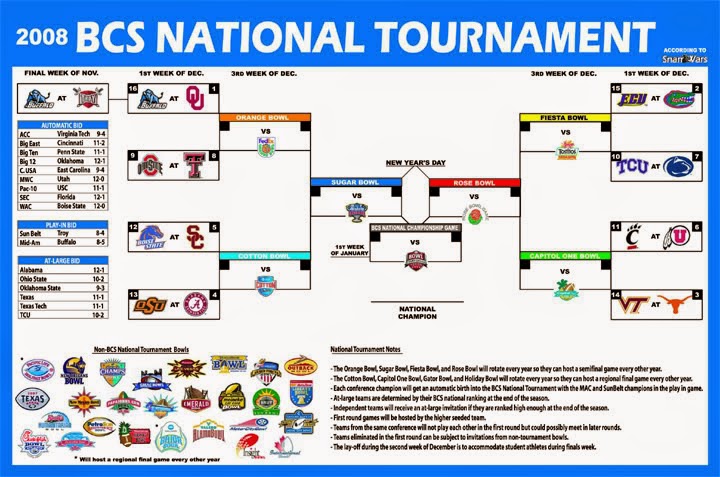
Before the four-team system was created, I’ve played out in my head a scenario. What if we go to the furthest extent possible and create a 16-team playoff system? Even better, no heavy drinking was required in the making of this scenario in my head. Having such a tournament is a better way to truly determine, on the field, a “one true champion” … to rule them all. (See what I did there?) Way better than a computer helping to determine a No. 1 and No. 2 team. You BCS apologists may call that fair, but IT’S A FREAKING COMPUTER. I dunno but I like it when champions are crowned in a final game, on a field. And we Americans, for the most part, love us some playoffs.

A championship tournament of some type exists for most every other level of sport out there. Wow. What a startling concept. Even the Kazahkistani kick-goathead league has a playoff. I’ve won some money there. I've lost even more money there. Without the NCAA basketball tournament, schools such as George Mason and Butler likely would have never made it to the Final Four. You have seen Gonzagas and Marquettes make their mark on the national scene. Without the College World Series, schools such as Cal State-Fullerton and Long Beach State -- not so much a Texas or USC -- get to shine and quite often.

My hypothetical 16-school playoff system would not mess with the current bowl system. Well, not half of it. Such a system wouldn’t screw with the “bowl games are a tradition” and “schools will lose money” and “you can’t make the student-athletes play that long or late into January” philosophies. Or that December playoffs would complicate things for students studying for finals. Welp, a tournament hasn't hurt FCS or Division II or III or NAIA schools. None of those arguments really work.

In most existing playoff systems/postseason tournaments, the most "deserving" teams make the playoffs, not necessarily the ones picked "the best." There's a difference. We can debate all we want about good losses, bad losses, strength of schedule, etc., during the regular season, but when it comes down to the nitty gritty to determine an absolute champion, why not go the way of a full tournament?

This is what I'd do to create a 16-team tournament. You start with automatic champions from FBS (Football Championship Series) conferences, be it regular-season champs and/or championship game victors. Yes, I know some of you have trouble with the existence of a conference title game. I see both sides of the debate have valid points, but I’ll stick what exists for the moment.

If there are co-champions, it’s up to the affected conference to determine who gets what we’ll call an FBS bid. You could combine the final regular season total average poll ranking with regular-season head-to-head outcomes for a tie-breaker. (Sound unfair? Good. You get to retain some semblance of unfairness in the process of arriving at a final national champion).

You could average the rankings of the AP, ESPN power, USA Today and Legends polls, emphasizing which schools get the most place votes, add the Congrove computer rankings, and arrive at a final aggregate Top 25 poll (a de facto old BCS-style ranking system, if you will, without the computer interference). Those are arguably the strongest, long-standing, most popular and credible of Division I polls.

Here’s what a final 2014 FBS aggregate poll would look like, with current conference titleholder status and final regular season record:

1. Alabama (12-1 SEC champion, title game winner)
2. Florida State (13-0 ACC champion, title game winner)
3. Oregon (12-1 Pac-12 champion, title game winner)
4. Ohio State (12-1 Big 10 champion, title game winner)
5. Baylor (11-1 Big 12 “co-”champion, LOLz)
6. TCU (11-1 Big 12 “co-”champion, LOLz)
7. Michigan State (10-2 Big 10)
8. Mississippi State (10-2 SEC)
9. Georgia Tech (10-3 ACC title game runner-up)
10. Kansas State (9-3 Big 12)
11. Ole Miss (9-3 SEC)
12. Arizona (10-3 Pac-12 title game runner-up)
13. Georgia (9-3 SEC)
14. UCLA (9-3 Pac-12)
15. Missouri (10-3 SEC title game runner-up)
16. Arizona State (9-3 Pac-12)
17. Wisconsin (10-3 Big 10 title game runner-up)
18. Clemson (9-3ACC)
19. Auburn (8-4 SEC)
20. Louisville (9-3 ACC)
21. Boise State (11-2 Mountain West champion, title game winner)
22. LSU (8-4 SEC)
23. USC (8-4 Pac-12)
24. Utah (8-4 Pac-12)
25. Nebraska (9-3 Big 10)

Marshall (12-1 Conference USA champion, title game winner)
Northern Illinois (11-2 Mid-American champion, title game winner)
Georgia Southern (9-3 Sun Belt champion)
Memphis, Central Florida, Cincinnati, (9-3 each, co-American Athletic champions)

Ultimately, FBS automatic bids would go to Alabama, Florida State, Oregon, Ohio State, Boise State, Marshall, Northern Illinois, Georgia Southern, Baylor (after winning the head to head with TCU), and Central Florida, or UCF (having the stronger Congrove computer power ranking over Cincinnati and Memphis).

You add any top independent team ranked high enough overall in polls for an FBS bid and/or four (or five) other highest-ranked schools, overall in polls. So this year these schools get an at-large bid: TCU, Michigan State, Mississippi State, Georgia Tech, Kansas State, Ole Miss

The ultimate FBS tournament seedings in a 16 vs. 1, 15 vs. 2, 14, vs. 3, etc. format would be:

1. Alabama
2. Florida State
3. Oregon
4. Ohio State
5. Baylor
6. TCU
7. Michigan State
8. Mississippi State
9. Georgia Tech
10. Kansas State
11. Ole Miss
12. Boise State
13. Marshall
14. Northern Illinois
15. UCF
16. Georgia Southern

Take into account the oldest, popular, most lucrative, traditional bowls and mix in some regional flair and considerate schedules. (I still await the Roady's Truck Stops FreeCreditReport.com Pomegranate Cherry Salad Bowl presented by Franklin American Mortgage Company, but I digress.)

All joking aside, use 15 of those prestigious, richest, most famous (i.e. powerful, established) bowls as the FBS bowl matches. All other bowls, may remain independent and ongoing aside from the FBS contests, some may provide comedic fodder to those of us snarkiest bunches on Twitter. No changes needed there.

Rotate the FBS bowls as quarterfinal, semifinal and final games, all of which could retain and maybe even increase the number of ticket-buyers, TV viewers and payouts. One reason? There’s even greater incentive to play in such a bowl. Not just one bowl. But a series of true head-to-head games where all the conference champions (not just the typical, known powerhouses) and other top-ranked squads have a genuine (and fair) shot at an undisputed national title. Throw in serious regional, tie-in considerations and, voila. Imagine that!

The younger, Decemberish bowls host quarterfinals on Tuesday, Wednesday, Thursday and Friday, given this year’s calendar: 1 vs. 16, 2 vs. 15, 3 vs. 14, 4 vs. 13, 5 vs. 12, 6 vs. 11, 7 vs. 10, and 8 vs. 9.

Tuesday, Dec. 16
Boise State vs. Baylor -- TicketCity Catcus (formerly Copper, Insight, Buffalo Wild Wings); Tempe
Georgia Southern vs. Alabama -- TaxSlayer (formerly Gator); Jacksonville

Wednesday, Dec. 17
Georgia Tech vs. Mississippi State -- Buffalo Wild Wings Citrus (formerly Tangerine, Capital One); Orlando
Northern Illinois vs. Oregon -- National University Holiday; San Diego

Thursday, Dec. 18
Marshall vs. Ohio State -- Outback (formerly Hall of Fame); Tampa
Kansas State vs. Michigan State -- Valero Alamo;

Friday, Dec. 19
Ole Miss vs. TCU -- AutoZone Liberty; Memphis
UCF vs. Florida State -- Duck Commander Independence; Shreveport

Probable winners?
Baylor, Alabama, Georgia Tech, Oregon, Ohio State, Kansas State, Ole Miss, Florida State

More bowls in following week's semifinals involve 1-16 vs. 8-9; 5-12 vs. 4-13; 6-11 vs. 3-14; 7-10 vs. 2-15.

Friday, Dec. 26
Kansas State vs. Florida State -- Goodyear Cotton; Dallas
Baylor vs. Ohio State -- Allstate Sugar; New Orleans

Saturday, Dec. 27
Georgia Tech vs. Alabama -- Chick-fil-A Peach; Atlanta
Ole Miss vs. Oregon -- Hyundai Sun; El Paso

Probable winners?
Florida State, Baylor, Alabama, Oregon

Final Four of sorts/Friday, Jan. 1
Baylor vs. Alabama -- Rose Bowl, Pasadena
Oregon vs. Florida State -- Fiesta Bowl, Tempe

Probable winners?
Baylor, Oregon (haha)

Championship game, Tuesday, Jan. 12
Baylor vs. Oregon -- Orange Bowl, Miami

Who wins? Forget all your worries about health care, immigration, ISIS, the Philadelphia 76ers and the Kardashians. Well, let this unfold in reality.

Sunday, November 9, 2014

"Interstellar" has much heart but far from perfect

Let's get this out of the way. I do like "Interstellar." A lot. I don't love, love, love it. It's not in my top 10 best movies ever. It's not director Christopher Nolan's best. I had high expectations going in to see "Interstellar." It's a good/bad thing. People already comparing it to "2001" or "Gravity." Once you've seen the movie, it's either the greatest or worst thing you've seen and seemingly there's no in between.

In the previous films, Christopher and brother/regular film partner Jonathan Nolan are responsible for blending tense action with explorations of morality, philosophy and what is real and what is an illusion. In a sense, that's no different in "Interstellar." The special effects and cinematography are stunning and what you'd expect from a Nolan cinematic spectacle, like we've seen in The Dark Knight trilogy, Insomnia, Memento and Inception.

The acting, for the most part, is solid. But being a geek you can't help but wonder what could have and should have been when it comes to the science, the inevitable plot twists/holes and those aforementioned explorations into existentialism.

I'll do my best to spare you spoilers. It's the not-too-distant future where Earth's environment has gone awry. The planet is drying. Agriculture is wasting away. Many parts of the world have become a dust bowl. Animal and plant species are going extinct fast and, apparently, wars have become obsolete. So has the need to preserve the best of what humanity had accomplished in the way of exploration, especially into space, the final frontier. School textbooks have been edited, and even NASA officially has been deactivated.

Enter Cooper, played well by Matthew McConaughey, a former hot shot NASA test pilot/engineer who never got to venture into space. He's a farmer now, an among many who are trying to save the world through primarily corn crops.

With help from his own dad (John Lithgow), Cooper raises his two kids. His daughter Murphy is a spark plug of sorts. One day she complains to her dad about a "ghost" in her bedroom, an unseen force that knocks several items from her large book shelf. Eventually we learn there's not really a "ghost" in Murph's bedroom (spoiler alert) but something else...and a larger anomaly, a mysterious message that leads Cooper to a nearby secret (and rather gigantic) NASA lab.

There, Cooper's former colleague, a physicist named Dr. Brand (Michael Caine) and others have been laboring to respond to a wormhole that was discovered years ago. Inexplicably, an officially shuttered NASA has managed to dispatched manned crafts deep into space to find the wormhole and see if there's a way to a new place humanity could possibly call home.

The previous missions have turned up essentially nothing and Cooper is mankind's best last chance to pilot a successful mission. I won't go further into detail but suffice it to say, the trip - visually - is stunning. It is thrilling, adventurous and makes one wonder about the mysteries of wormholes, gravity, black holes, time relativity, dimensions and what may or may not exist on other worlds.

Moreso, there are debates about what aspects of the human condition. Admittedly this is where the script gets a bit clunky. The science isn't precise as a nerd would want from even a movie like this, in spite of the involvement of renowned astrophysicist Kip Thorne. The script leans heavily on Thorne's work and, what mankind has learned from centuries of scientific research. From there, "Interstellar" exhibits things like Einstein's curvature of space and time relativity like no movie has previously demonstrated. But like with everything else in entertainment, a few things must be shortchanged for the sake of dramatic license.

Visually and musically, the Nolans tip their hats to "2001" and a hodgepodge of previous movies (good and bad) that, like "Interstellar," strived to be profound and visionary in their examination of human existence and mankind's place in the cosmos. There are robots that appear like an homage to HAL 9000 and even the clunky ones in Disney's "The Black Hole." Hans Zimmer's score sounds like a hybrid of a Philip Glass overture and something more similar to his works in the Dark Knight films and "Inception."

The third act, while appropriately intense, has a subplot/twist that I'm unsure whether it was necessary. I did roll my eyes. Ultimately, the heart of "Interstellar" is the father/daughter relationship, a bond broken seemingly for the worse once Cooper leaves his young girl behind to save the world. That young girl, while feeling initially shattered at the thought of never again seeing her father, grows up strong and becomes key to Cooper's efforts to save humanity.

I may need a second viewing of "Interstellar." Probably a few more viewings as time goes along. Is it impressive as "2001"? No. Nothing can really top that but "Interstellar" tries its hardest to aspire a tribute, and I admire that. But those McConaughey Lincoln commercials and his role in "True Detective" are making a lot more sense now.

Sunday, October 5, 2014

Wrapping up comic-con, Alamo City 2014-style.

I almost forgot to link my blog to the final of my 2014 local comic-con pics.

And here's my Express-News story about local horror author Tim Miller, who appeared at the recent Fantom Fest at the Menger:
 
http://www.mysanantonio.com/news/local/communities/alamo-heights/article/Local-author-pushes-boundaries-of-horror-5797142.php


And my report on the professional cosplay panel discussion at Alamo City Comic-Con:

http://www.mysanantonio.com/news/local/communities/alamo-heights/article/For-cosplayers-sometimes-it-s-a-lot-of-work-5797141.php


Sunday, September 7, 2014

This 'Congress' you'd at least consider over the real Congress

Isn't it fun stumbling upon a work of art...movie, book, TV show, static art...that confounds, angers and delights you all at the same time? Then you try to explain it to someone else, much less yourself, and find that you simply can't. It just is. That's "The Congress" for you. It's a daring film by director Ari Folman of "Waltz with Bashir" fame and loosely based upon Stanislaw Lem's book "The Futurological Congress."

The set-up is basic but provocative enough. Imagine a world where Robin Wright plays herself who indeed shot to stardom in 1987 with "The Princess Bride." (Gawd, has it really been that long ago?) Her star has fallen over the years. With no mention of her being in "House of Cards," "The Congress" envisions Wright as a single mom of two kids, living in an abandoned structure near an airport. Few if any movie studios want to work with her, and her longtime agent Al (an unusually restrained Harvey Keitel) struggles to find her work. But there's one final option and it's a doozy.

Miramount Studios (get it...a play off of Paramount and Miramax?) wants to scan Wright, literally, all of her physical and emotional features and preserve them in digital form. Wright herself won't have to work anymore, but gets paid a hefty sum to have her younger, digital version play roles such as a short-cropped, weapon-slinging rebel of the future. Her new "roles" make millions for the studio; one such role is almost a parody of Ben Stiller's Tugg Speedman character from "Tropical Thunder." Wright balks initially at the thought, but thinking of her children, the ugly reality of her situation, the creepy studio head (Danny Huston) puts it bluntly: The digital version of Robin Wright will do things the real Robin Wright wouldn't do, especially the one now in her 40s.
Twenty years later, Miramount is a world-dominating megacorporation - more than a movie studio - and it's unleash its latest, most powerful product at its cultural confab, The Congress. Miramount has figured out how to reduce an actor's chemical makeup to a drug. Yes, you as a fan can literally eat/drink/inhale your favorite performer and imagine yourself as someone/something else. Everybody else does. Heck, at this point Hollywood has become an animated zone, as in Roger Rabbit's Toontown on steroids. In effect, the entertainment business has become an opiate for the masses that yearn to retreat from an increasingly ugly real world.


Wright is asked to speak to the greatness of what's happening and, well, I'll spare you the rest of the plot. The story doesn't really matter. What matters in "The Congress" is what is seen and done. Visually, especially the animation part, is stunning. Some of the satirical characterizations are hilarious. Some people online criticize the animation part, calling it cheap. I think it's partially because it's meant to be inexpensive. This is an indie/art house flick, after all. So much of it recalls classic cartoons of old, but more so it speaks to some people's desire to escape from their reality and enjoy how they want to be seen/perceived rather than how they are in real life.

Folman touches upon so many themes in his film: Identity, one's hold on reality, free will, capitalism, imagination. The film is a critique of the movie industry, how it treats aging performers, and its plans for a more digital universe. There's a critique about overmedicating our population. "The Congress," visually, is filled with inspiration ranging from "Inception" and "2001" to "What Dreams May Come" and "Solaris."

Wright herself portrays "herself" well but appears a bit distant. I'm sure if she's directed by Folman to be a tad distant or she's just that way, as she was in many of her previous films. With its mish-mash of live action and animation. "The Congress" says something on the whole, but it does feel incoherent in bits and pieces. I'm still trying to figure it all out. Maybe there's a point. Maybe there's not! But it's a philosophical, entertaining, mindblowing trip all the same.

Monday, August 4, 2014

Guardians of the Galaxy equals geekgasm

I would've posted a review much sooner this past weekend if it weren't for my crazy attempts to keep up with coverage of Wizard World Comicon and San Antonio Film Fest. Plus, there was that trip to Austin for the grand opening of Oasis Texas Brewing Company. Hooray, beer.

But I digress. In previous months I had read, with some interest, people discussing concerns about a Guardians of the Galaxy movie. The comics were fun without being silly but, in the greater Marvel comics to cinema universe, GotG isn't up to the level of Thor, Iron Man, X-Men, Spider-man or Captain America. That seemed to be a consensus of many online informal chats leading up to the release of the first trailer of the movie.

The trailer was hilarious and entertaining, but also positioned the movie just right. What a treasure trove awaited the fans. Judging by debut weekend box office numbers, many, many fans took in Guardians of the Galaxy and loved it. I did, too. One person remarked "It's basically Raiders of the Lost Ark in space." Sure, but it's also parts Buck Rogers, Flash Gordon and all the exuberant sci-fi comics, movies and TV shows from my childhood (well, mine anyways) that were swashbuckling, daring, edgy but not overboard in any particular way.

The casting is almost pitch perfect. The special effects, action set pieces, cinematography are beautiful and don't look so overly CGI'd or gaudy (you hear me, Spider-man?!). As with most comic adaptations, it's the little things that make a big impression: Peter Quill's/Star-lord's memory of his mother kept alive by songs you know and will be humming for weeks. Quill's devil-may-care attitude. A better look around The Collector's collection, a longer look than in Thor: The Dark World. ESPECIALLY in the post-credits, which is almost a jab at DC/Warner's fumbling around with comic cinematic adaptations. Baby Groot. Rocket pouring his torn, jagged heart and soul out after a drunken fight with Drax. Yondu's redass personality (a perfect fit for Michael Rooker, long a fan of the comics character). Drax with his heart of gold and despair. Gamora's ass-kickingness that briefly disappears when she's almost won over by the charms of Quill. Lee Pace bringing the pain as Ronan the Accuser. Josh Brolin growing clearer and clearer (in the Marvel movie universe) voicing Thanos. Hell, even with her villainous character Nebula, I've grown more in love with Karen Gillian. It's all there in its splendor.

Guardians of the Galaxy is one of those comic adaptations that perfectly makes fans out of those new to the material. But it doesn't dumb things down for the hardcore fans. The audience could connect, in a sense, with this bunch of outcasts, misfits and criminals. I loved Captain America sequel, I was fine with the Thor sequel, and from the sounds of things, Avengers 2 will be tremendous. I'm worried about what's happening with Ant-Man, how Marvel bungled that in the wake of Edgar Wright's departure. But with James Gunn, the Guardians are in the right hands. I hope to see it again soon, and eagerly await the sequel.

Saturday, July 12, 2014

Toast to The Rise of The Dawn of the Planet of the Apes

For a summer blockbuster, "Dawn of the Planet of the Apes" offers nuanced direction, pulse-pounding music, astounding art direction, a basic but driven storyline, and terrific special effects that don't ruin it all. While the acting isn't award-winning -- well, not from the human characters -- you do have characters you come to like or dislike. But you do learn to appreciate them. In other words, this isn't the loud, bombastic, non-sense that is the latest Transformers film, which has ruined my childhood -- again.

"Dawn of the Planet of the Apes" picks up a little where we left off with the "Rise of the Planet of the Apes." A quick, unnerving beginning scene uses real shots of riots and people addressing outbreaks to quickly take us through the history of the fictional simian virus, which has killed off most of humanity in a decade and leaving Caesar and his genetically-enhanced fellow simians to evolve to become almost dominant species on Earth. A scouting trip for a small band of humans from the ruins of San Francisco into the forests of Northern California triggers conflict with Caesar in his clan.

How far have special effects come in the last few years? Astounding work by WETA Digital in putting realistic touches to the variety of apes portrayed. But Andy Serkis deservedly gets top billing as Caesar. The first film was more about humanity's hubris.... a drive to create a cure for a disease turns into a death sentence for mankind and gives way to simians to assert their power--maybe reassert is the proper term.

This film is about Caesar, raising his family, attempting to educate the rest of the simians. Loyalty, love and knowledge as power quick emerge as traits mutually shared between humans and simians. But not all the simians are interested in educating themselves and leaving the remnant of humanity to live in the ruins of its creation in some sort of uneasy coexistence. Some, if they have the opportunity and feel pushed, use revenge as a reason to kill humans.

But back to Serkis...he's more than the go-to guy for slo-mo capture effects acting. The guy can act, period. He has more than Gollum and King Kong in his arsenal. Caesar emotes strength, leadership, loyalty, perspective, compassion in his facial expressions, vocalizations, body language, the few words he learns to speak.

The few action scenes in the first hour and a half are relatively brief but filled more with suspense and drama then pure traditional action. As one ape turns on another in the build up to the climax, it's all leading to a pay off. It's like a war movie where the fate of every character, in the end, is unknown until the final sequence. It's parts thrilling, shocking and disheartening, the violence of it all.

Some of the music by JJ Abrams regular composer Michael Giacchino, and intricate direction by - yes- JJ Abrams colleague Matt Reeves, "Dawn of the Planet of the Apes" pays a bit of tribute to the old, classic "Planet of the Apes" flicks while preparing a new generation for a new slate of "Apes" films that look just as exciting. And we've almost erased the memory of Tim Burton/Mark Wahlberg's unfortunate "Planet of the Apes" remake.